
Why You Pay Different Prices for the Same Bank Service

Constance Véron
Managing Director

Nate Guers
Director

Cash management pricing drifts as a company grows and time passes. Here is how that happens, what it costs you in fees and in unearned yield, and what it takes to bring it back into line.
Pull the fee statement (or account analysis) from two of your banks. Now compare them side by side and identify what each one charges for the same service; for example, an ACH transaction or a monthly maintenance charge. There is a fair chance that the two numbers are different.
Sometimes the pricing differs at the same bank, for the same service, across different accounts that are operating at that bank. Multiply that cost differential across every bank service utilized, and bank account a large company holds, and the gap stops being a rounding error and becomes material.
This is one of the most common things we find when looking at a company’s bank fee statements. Most of the time, that difference has nothing to do with anyone acting out of greed. The differences build up slowly, over years.
These costs land in two places at once: the fees you pay (really, overpaying, that you cannot retrieve). No different from an airplane taking off with a seat empty; revenue the airline cannot retrieve once the plane leaves the gate.
Both are fixable, but neither fixes itself.
How Bank Fees Drift: Why the Same Service Ends Up with Two Prices
As companies grow (whether organically or through acquisition), the number of bank accounts grows, and their pricing tends to fragment without anyone intending it. A new entity gets its own accounts, and an acquisition shows up with its bank fees already attached. Other times someone opens an account to handle an immediate problem, and the bank applies its standard pricing because nobody was in the room to ask for better or to ensure that pre-negotiated pricing is applied to newly opened or acquired accounts.
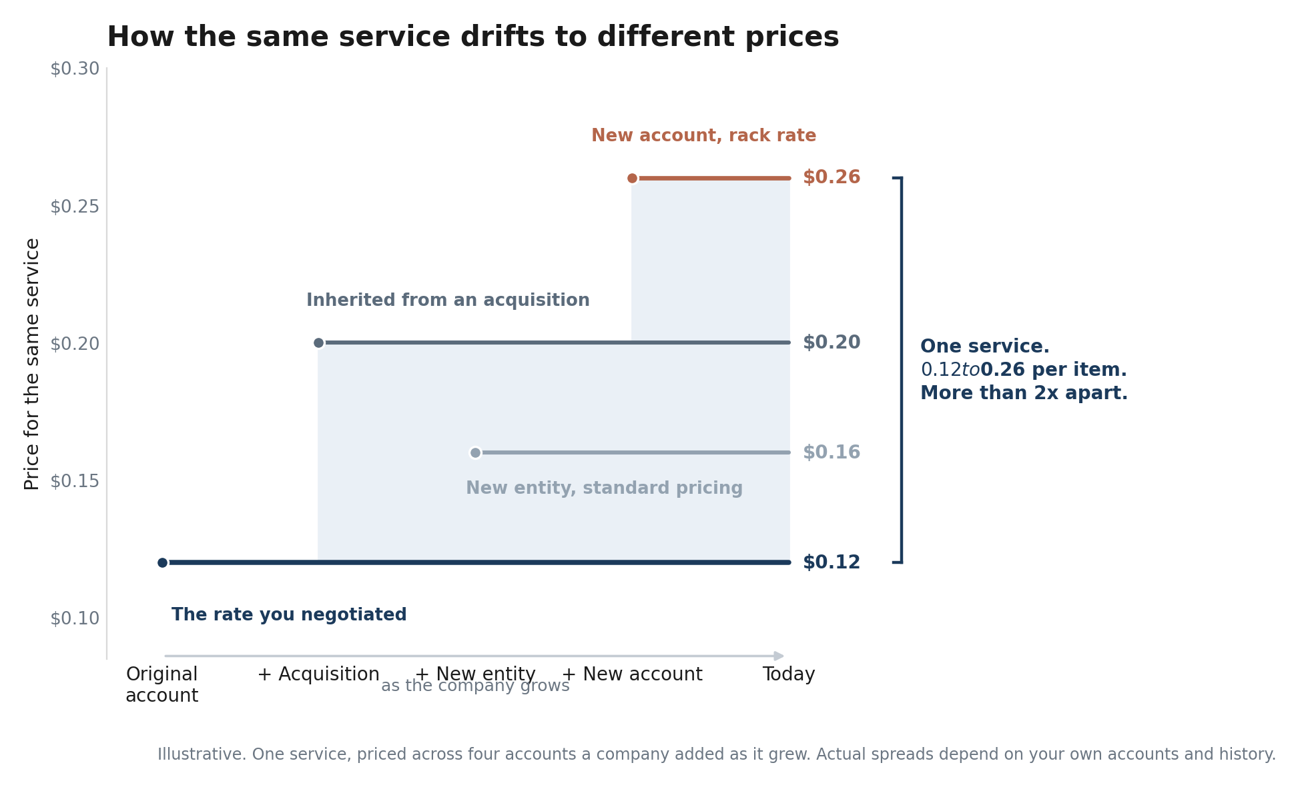
The bigger driver is structural, and it is the part most treasury practitioners never realize. Inside the bank, your accounts sit under billing structures. When those structures are not linked to each other, pricing in place for one set of bank accounts does not necessarily carry across to another set of bank accounts.
Similarly, balances in accounts earning one specific yield or ECR rate may be different from the rate that balances in other accounts are earning. Add to that: relationship managers change; older rates get grandfathered, and newer accounts are then charged at the “rack” rate. None of it is coordinated or scrutinized, because no one ever sat down to make it foolproof. The more entities, banks, and billing structures you carry, the further your pricing fragments and becomes more difficult to follow.
Almost always, the cause is simply complexity. Banks run on legacy systems and complicated account hierarchies of their own, and a charge can get mapped to the wrong code as easily as a negotiated rate gets missed on a new account. The real issue is the time and capacity to create this comparative view. No one is watching the whole picture on your behalf.
Areas Affected the Most by Inconsistent Pricing
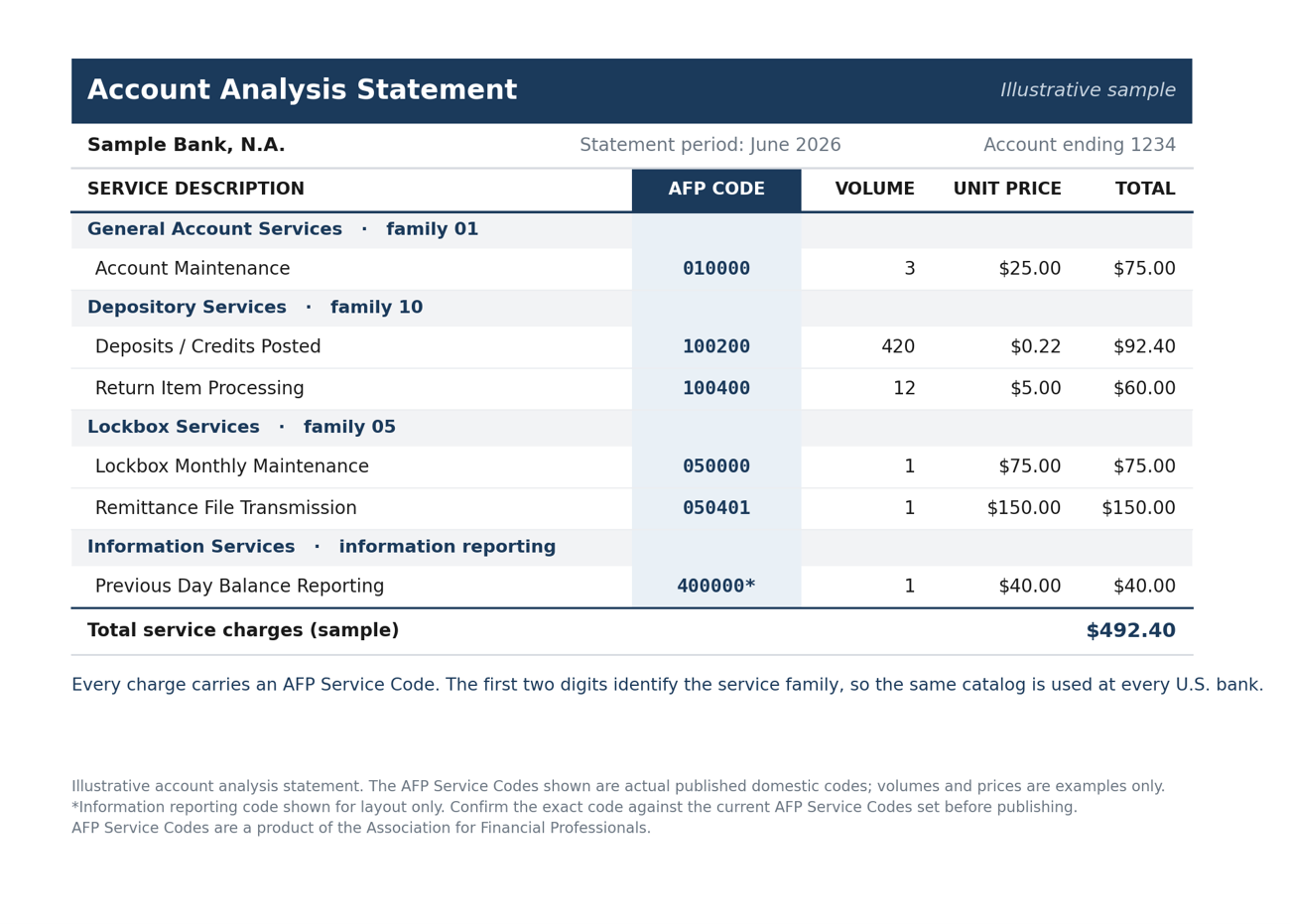
In the terms of AFP categories (AFP codes are the service codes labeled by banks to classify your families of charges in Account Analysis Statements), there are a few where inconsistent pricing may impact your company the hardest.
For instance, maintenance fees (e.g., General Account Services, AFP family 01) may contain charges for additional accounts that exceed the rates originally negotiated. Depository services (Depository Services, AFP family 10) are constantly increasing and may fluctuate from one account, entity, or BU to another. Information reporting (Information Services, AFP family 40) can vary significantly across business sectors, where different reporting needs and toggling across services can lead to fragmentation. You can learn more about AFP codes here.
Behind the Fees: Earnings Credits and the Yield on Your Balances
Fees are the visible half of this. The balances behind them are more hidden, and often a more costly negligence. Many companies keep large balances parked in bank accounts to help cover their fees through earnings credits, or because they want to keep liquidity readily available. Using these associated account balances to offset fees is an effective way to manage banking costs. However, the bigger opportunity comes from considering those balances and the associated yield, alongside the fees they offset, rather than treating the two as separate parts of the relationship.
When pricing with your banks is harmonized through an engagement with Redbridge and the structure is clean, two things happen simultaneously: The fees come down to competitive market prices, and the balances that were tied up behind those misaligned structures can be combined and positioned to work as a larger generator of yield. Our team calls this “simultaneous optimization,” where pricing and balances improve at the same time rather than one or the other.
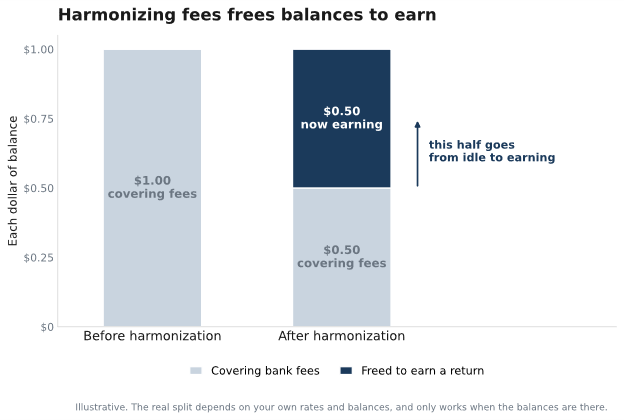
The mechanic is simple: Say a dollar of balance was being used entirely to offset a dollar of fees. Bring the fee down so it takes only fifty cents to cover, and the other fifty cents is free to earn a return. The real figures depend on your own rates and balances, which is the honest catch. None of this works without balances to begin with, and when the balances are there, the fee work and the yield work compound on each other.
Why a Phone Call to Your Bank Will Not Harmonize Your Pricing
The obvious move is to call your relationship manager and ask for a lower price, and that instinct only gets you so far. Knowing that one account pays more than another does not tell you what the right price should be, or whether the charge is even coded correctly in the first place. It does not give you a single view of every bank service across every bank account at once, which is what you need before you can negotiate from strength across dozens of billing structures. Visibility must come first, because the negotiation only works once you can see everything.
Bank Fee Harmonization: From a Full Audit to Negotiated Pricing
Effective negotiation depends on full visibility of the banking relationship. This requires a comprehensive audit that considers all bank accounts and captures every fee, balance, and yield earned (or not earned) across the relationship. It must also reveal whether each fee is being charged consistently from account to account, and each charge is accurately mapped to its corresponding AFP code, allowing for rigorous cross-bank comparison rather than guesswork.
From there, it becomes a negotiation. Harmonized pricing means the same fair rate for the same service across all of your banks and bank accounts, written into a contract that holds for a multi-year term so the drift does not quietly start the moment you look away.
Redbridge runs this work as an independent advisor. Because our team gathers pricing across hundreds of clients and thousands of bank relationships every month, the complete scorecard (benchmarked to the market) tells you whether a given fee increase is hitting everyone or only you, which is often the most reassuring thing a treasury team hears all quarter.
None of this treats the bank as the opponent. The goal is fair value from a relationship you plan to keep.
When to Review and Harmonize Your Bank Fees
Most teams come to this during a push to cut costs, or right after realizing the fees have not been renegotiated in close to a decade. You do not need a crisis to justify the look. Even well-run treasuries that harmonized everything once will drift again as they add entities and accounts, or just because time passes. The value here is easy to understate, since most of what it delivers is the cost you never pay and the yield you stop missing, the kind of prevention that only shows up in the numbers later.
If you want to know where your own pricing stands, that is exactly what a bank fee assessment is for. Redbridge will show you where your accounts disagree with each other, and what that disagreement is costing you. For more reads like this one, you can subscribe to the Redbridge newsletter.
Ready to Take the Next Step with Redbridge?
Complete the contact form and get started with a free benchmark.