
Digital Transformation in Treasury
Our team provides useful information to industry practitioners, through various articles, studies and research.
Digital Transformation in Treasury
How 2022 Will Transform Your Treasury Department
2020: The Year In Review

Payments Report – Shifting to faster payments

Treasury Forecasting: An Overview Of Practices
Payment Cards 101: The Ultimate Guide
Global Availability of Electronic Bank Billing Formats (BSB) 2018 Bank Survey Results
Commodity Trading Firms: Finance Perspectives
Digitalization, customer path, and new payment methods
Global Availability of Electronic Bank Billing Formats (BSB)
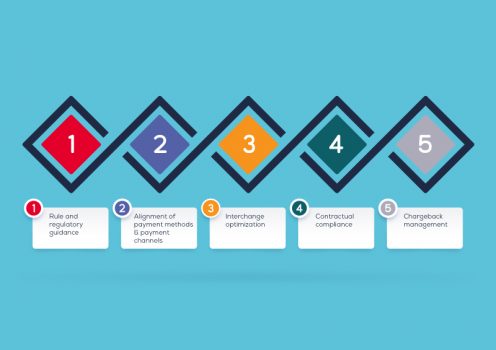
Chelsey Kukuk, Managing Director at Redbridge, gives her insights on outsourcing the payment acceptance strategy and the many benefits that come along with it.

In record time, banks appear to have stepped up and deployed much-needed liquidity to global commodity traders, especially to metal traders affected by unseen circumstances in the LME (London Metal Exchange). For Mihai Andreoiu, Senior Director at Redbridge, the current crisis re-surfaces some older questions, like can commodity traders keep relying mainly on bank (uncommitted) lending?

We have all seen QR (Quick Response) codes in our daily lives. These scannable, square-shaped, two-dimensional barcodes serve a similar purpose as traditional barcodes, but they can hold much more information.

With all of the uncertainty in today’s world – economic turbulence and political turmoil – it’s more important than ever for businesses to be able to forecast future cashflows accurately.

When diving into the fast growing E-commerce market space, one of the most important avenues to consider from a merchant’s standpoint is securing the cardholder’s data.

Global Treasurers are continually striving to streamline account structures and centralize transaction processing. Increasingly, they are turning to virtual accounts as a key tool to provide this comprehensive view of their cash position and improve their decision-making process. However, in spite of certain advantages, virtual accounts have some difficulties when being integrated into the landscape of companies.

In a position paper reflecting Redbridge’s views on sustainable financing, Muriel Nahmias, Managing Director – Debt Advisory, analyzes the consequences of a foreseeable disappearance of the incentives (bonuses) commonly granted in the context of ESG financing.


Almost every company has some sort of external rating of its creditworthiness. For larger companies that issue debt in the public markets, this may include ratings by the well-known rating agencies such as S&P Global, Moody’s and Fitch Ratings. Companies are also assigned ratings by their banks, certain credit insurance providers, and third-party credit monitoring services. Let’s take a look at the primary reasons why these ratings matter.


In-house banking provides a number of advantages to financial departments when it comes to managing their cash flow more effectively: it helps them combat fraud, control financial risks and optimize their working capital requirements. Jéromine Adler and Arielle Chave, consultants in Redbridge’s Treasury Advisory team, highlight some of the keys to success when it comes to such projects.

Due to the recovery of industrial production and international trade, working capital has become one of the main challenges finance departments are facing today. Asset-based financing solutions can facilitate working capital management, diversify sources of financing and optimize the cost of debt. Listen to our November 16, 2021 market update on key players in factoring and reverse factoring businesses in Europe.

Mihai Andreoiu assesses the health of the commodity trade finance sector in a boom period and asserts that now is the best time to monetize trust and relationships with resilient banks and new financing partners.

The U.S. Department of Justice’s plan to probe Visa’s debit card routing practices and what it means for businesses

The world of payments is in a permanent evolution but some changes are bigger than others. In today’s environment, where commercial exchanges are globalized, payment transactions are tremendously varied, numerous and complex. To tackle this point, the payment industry is preparing itself for the largest migration of the century: the migration to ISO20022.


